Private API Documentation for Partners and AI Agents: Access, Scope, and Governance
Learn how to govern private API documentation for partners, customers, internal teams, and AI agents using identity, scoped access, entitlements, and review controls.
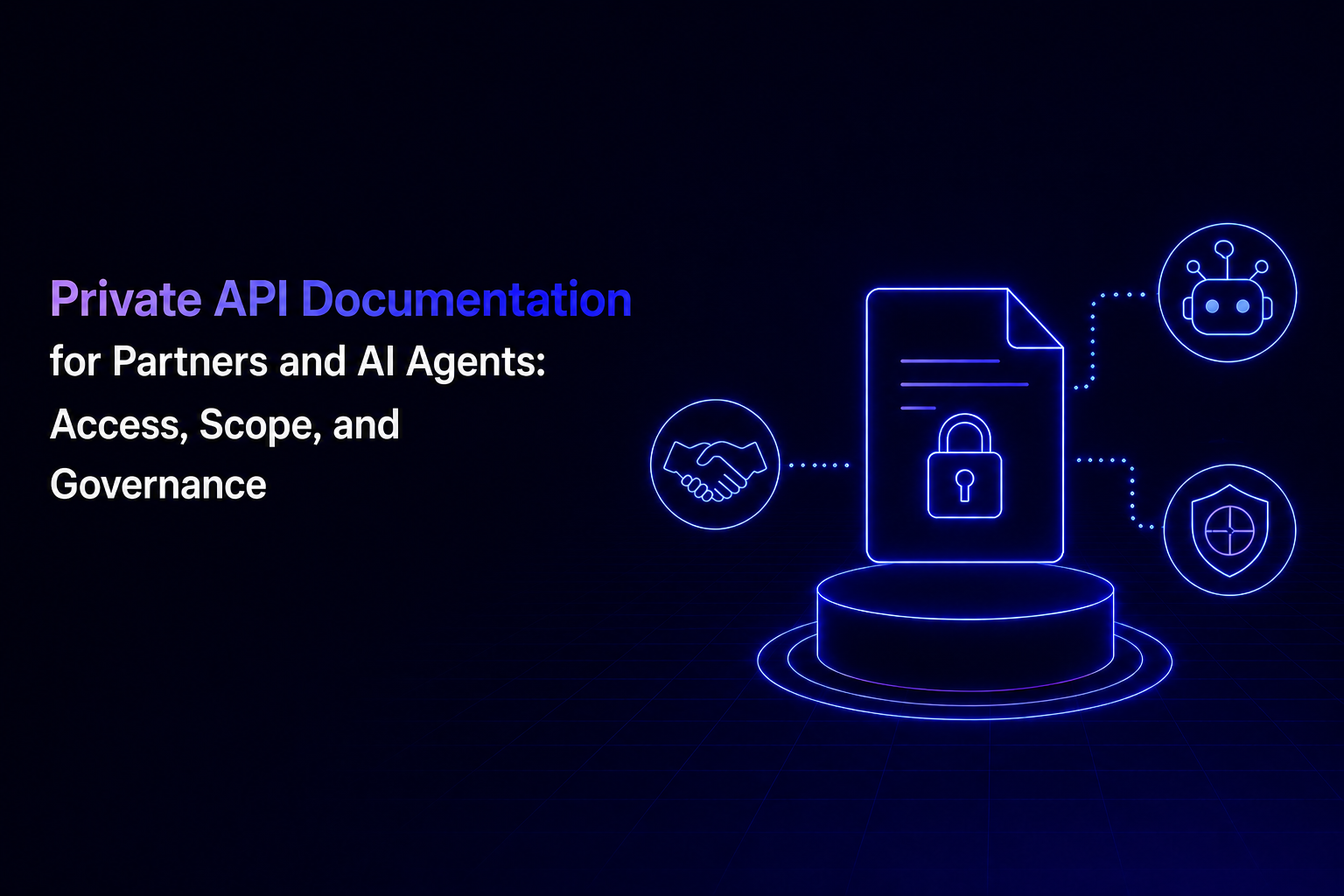
Private API documentation is an access-controlled developer portal that shows each partner, customer, internal team, or AI agent only the APIs, guides, SDKs, and environments they are authorized to use. A strong setup combines identity, content scope, least-privilege permissions, lifecycle controls, and auditable review. A login screen alone is not governance.
For B2B SaaS and fintech teams, the goal is to reuse one governed documentation source while presenting different approved views to different audiences. Public discovery content can remain open, partner integration guides can require authentication, customer-specific endpoints can be restricted by entitlement, and AI agents can receive only the context and tools permitted for their identity and task.
What makes API documentation private?
API documentation is private when access depends on a verified identity and an explicit authorization decision. The portal should evaluate who is requesting access, which organization or role they belong to, what content they are entitled to see, and whether that access is still valid.
This is different from hiding a URL, excluding a page from search, or sharing a password across a partner team. Those approaches reduce discoverability but do not provide reliable identity, revocation, segmentation, or accountability.
- Authentication confirms the visitor or agent identity.
- Authorization decides which APIs, sections, endpoints, guides, SDKs, and environments that identity can access.
- Governance defines who grants access, how it is reviewed, when it expires, and what evidence is retained.
Who needs a private API documentation portal?
Private portals are useful when one public documentation experience cannot represent the commercial, security, or lifecycle boundaries around an API program.
Partners
Partners often need integration specifications, certification steps, sandbox credentials, test data rules, and escalation paths that are irrelevant or inappropriate for the public site. Their access may depend on contract status, geography, product, or integration tier.
Customers
Enterprise customers may need customer-specific APIs, purchased modules, private SDKs, implementation guides, or account-specific configuration. A customer portal should expose only the content covered by that customer's entitlements.
Internal teams
Engineering, product, support, sales engineering, and operations may need pre-release references, internal runbooks, migration plans, and troubleshooting material. Internal visibility should still be role-based rather than automatically open to every employee.
AI agents
AI agents need machine-readable context, but they should not receive broader access than the human, service account, or workflow they represent. Retrieval and tool access should inherit the same audience, product, environment, and endpoint boundaries.
How should you define documentation scope?
Start with an entitlement model before configuring pages. Scope should be expressed in dimensions that map to the business and the API architecture.
- Audience: Public visitor, partner, customer, employee, contractor, or machine identity.
- Organization: The company, business unit, account, or partner program.
- Product and plan: Purchased modules, partner tier, beta program, or commercial entitlement.
- Environment: Sandbox, staging, production, regional deployment, or test tenant.
- API surface: Catalog entry, guide, SDK, endpoint, schema, changelog, or troubleshooting page.
- Version and lifecycle: Current, beta, deprecated, or sunset content.
- Action: View, search, export, test, ask an AI assistant, or invoke an agent tool.
A scope matrix is usually clearer than a long list of exceptions. For each audience, record the allowed products, environments, content types, actions, owner, review date, and revocation condition.
What access model works for partners and customers?
Use identity-based access with reusable roles and organization-level entitlements. Avoid assigning page permissions individually unless an exceptional case truly requires it.
- Authenticate the identity. Use SSO where it fits the customer's identity provider, or controlled email invitations and registration for external developers.
- Assign organization membership. Connect the user to the correct customer, partner, or internal group.
- Apply a role. Roles might include partner developer, partner administrator, customer developer, support viewer, or internal publisher.
- Apply entitlements. Entitlements narrow access by product, plan, environment, version, or API family.
- Review and expire access. Define renewal, inactivity, contract-end, role-change, and offboarding rules.
Theneo supports public, private, and customer-specific portals with custom domains, SSO, email invitations, access entitlements, and white-label interfaces. Its enterprise controls also include granular roles and permissions across API specifications, guides, changelogs, portals, and publishing workflows.
How should private documentation work for AI agents?
Give an agent a bounded identity and task-specific scope. Do not make private documentation public merely to improve machine retrieval, and do not give an agent a shared credential with unrestricted portal access.
Bind access to an identity
An agent should operate as a service account, scoped token, or delegated identity that can be traced to an organization and workflow. The documentation system should be able to distinguish the agent from an anonymous crawler.
Separate retrieval from action
Reading a guide is not the same as invoking an API. Define separate permissions for documentation retrieval, code or schema export, interactive testing, and agent tool use. A support agent may need troubleshooting guidance without permission to call a production endpoint.
Curate the exposed surface
Only expose the API operations, descriptions, examples, and resources needed for the task. Theneo's MCP workflow supports per-project exposure and private or header-based access, so teams can control which endpoints are available rather than publishing an entire API surface by default. Product behavior should always be verified against current documentation before rollout.
Protect context boundaries
Keep customer-specific, regional, beta, and internal sources separated. Retrieval systems can return a technically relevant passage from the wrong audience or version if the source boundaries are ambiguous.
What governance controls should a private portal include?
Governance turns a permission configuration into a repeatable operating process.
- Named owners: Assign accountable owners for each portal, API family, role, and entitlement rule.
- Approval workflow: Require an authorized business or product owner to approve external access.
- Least privilege: Start with the smallest useful scope and expand only when a documented need exists.
- Time limits: Expire beta, contractor, migration, and temporary support access automatically where possible.
- Separation of duties: Distinguish content authors, reviewers, publishers, portal administrators, and access administrators.
- Auditability: Retain access grants, changes, removals, publishing decisions, and relevant usage events.
- Incident response: Define how to revoke access, rotate credentials, remove exposed content, and notify affected owners.
- Periodic review: Review high-risk access more frequently than stable low-risk partner access.
How do you prevent content leakage?
Treat visibility as a content attribute throughout drafting, review, publishing, search, export, analytics, and agent delivery. Leakage often happens when one downstream representation ignores the portal's main access rules.
- Test anonymous, partner, customer, internal, and agent identities separately.
- Verify navigation, search results, direct URLs, exports, previews, API explorers, and AI answers.
- Keep secrets and production credentials out of documentation content even when the portal is private.
- Check that deprecated or unlisted endpoints do not reappear in generated indexes or agent tools.
- Use customer-safe sample data and scrub logs, screenshots, and copied error payloads.
- Review caches and search indexes after revoking or narrowing content.
What should the rollout checklist include?
- Inventory every API, guide, SDK, environment, version, and audience.
- Classify content as public, partner, customer, internal, or restricted machine access.
- Build the role and entitlement matrix.
- Choose authentication methods for each audience.
- Configure section and endpoint visibility.
- Define separate permissions for retrieval, testing, export, and agent actions.
- Test with representative identities, including an agent identity.
- Document approval, expiration, offboarding, and incident procedures.
- Launch to a small partner or customer cohort.
- Review access and feedback before expanding.
How should you measure a private portal?
Measure whether the portal delivers the right information to the right audience without weakening control. Do not treat page views alone as success.
- Leading indicators: Completed access reviews, time to approve access, expired grants removed, failed searches, repeated support questions, stale restricted pages, and permission-test pass rate.
- Lagging outcomes: Partner onboarding time, integration completion, support demand, time to first successful API call, security exceptions, renewal or expansion signals, and verified agent task completion.
AI visibility inside a private corpus is not a public share-of-voice metric. Evaluate it through sampled authorized tasks and traceable retrieval behavior. Deterministic claims about agent accuracy or citation are contested.
Design access around the relationship, not the page
A private API documentation portal should model the relationship between an identity, an organization, an entitlement, and an API surface.
When those rules are explicit, the same governed source can support public discovery, partner integration, customer-specific onboarding, internal operations, and scoped AI workflows without duplicating documentation into disconnected sites.
Theneo brings public documentation, private customer portals, access control, branded authentication, analytics, and agent-ready delivery into one governed developer experience. The implementation should still begin with an entitlement model, named owners, and human review.
Frequently Asked Questions
What is private API documentation?
Private API documentation is an authenticated portal that exposes only the APIs, guides, SDKs, and environments authorized for a specific identity or organization.
How should partners access private API documentation?
Authenticate each partner user, connect them to an organization, apply a reusable role, narrow access through product and environment entitlements, and review access regularly.
Can AI agents use private API documentation safely?
Yes, when each agent has a traceable identity and least-privilege scope, with separate controls for documentation retrieval, export, API testing, and tool invocation.
What should a private developer portal restrict?
Restrict content and actions by audience, organization, product, plan, environment, API surface, version, lifecycle state, and permitted activity.
How often should private documentation access be reviewed?
Review access on a risk-based schedule and immediately after contract changes, role changes, offboarding, security incidents, or major entitlement updates.