Self-Hosted API Documentation With SSO: An Enterprise Evaluation Checklist
Evaluate self-hosted API documentation with SSO across deployment, identity, security, operations, resilience, and ownership before you buy.
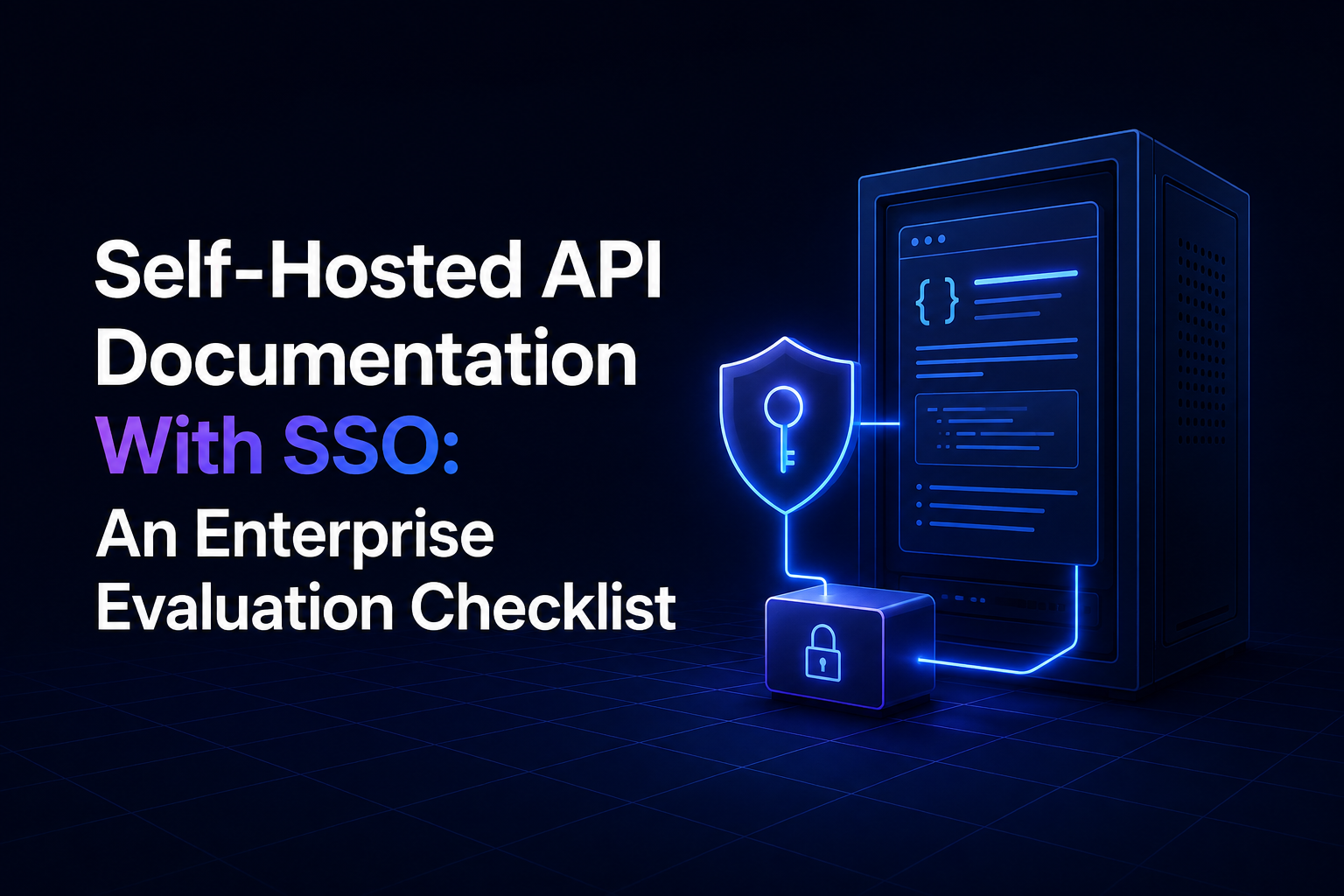
Short answer: An enterprise should evaluate self-hosted API documentation with single sign-on as an operating system, not a hosting checkbox. The platform must fit the organization's infrastructure, identity lifecycle, authorization model, security controls, publishing workflow, recovery requirements, and exit plan.
The strongest evaluation uses real architecture and real users. Deploy the platform in the target environment, connect the production-class identity provider, test multiple roles, revoke access, publish representative documentation, perform an upgrade, restore from backup, and verify that restricted content stays restricted. A vendor presentation cannot replace those acceptance tests.
What is self-hosted API documentation with SSO?
Self-hosted API documentation is a documentation platform that runs inside infrastructure controlled by the customer or an approved private environment. Single sign-on, or SSO, lets users authenticate through an organization's existing identity provider instead of maintaining a separate documentation password.
An application programming interface, or API, is the contract software systems use to communicate. A complete API documentation platform may include authoring, API reference generation, search, publishing, analytics, interactive testing, and administration. When a vendor says the platform is self-hosted, confirm that the complete working system is included, not only a static export of published pages.
The deployment may run in a public-cloud account, a private cloud, an on-premises data center, or a restricted network. The label matters less than the boundary: the buyer should know where the application, database, search index, files, logs, backups, and administrative access reside.
How should an enterprise evaluate self-hosted API documentation with SSO?
An enterprise should evaluate six connected areas: deployment, identity, authorization, security, operations, and documentation workflow. A platform should pass all six because a failure in one area can undermine the others. Secure hosting does not compensate for weak revocation, and strong SSO does not compensate for an unrecoverable deployment.
Record each requirement as pass, conditional pass, or fail. A conditional pass should have an owner, a remediation action, and a deadline before procurement approval.
Which SSO protocols should an enterprise documentation platform support?
Most enterprise evaluations should require Security Assertion Markup Language 2.0, known as SAML 2.0, or OpenID Connect, known as OIDC. The correct protocol depends on the organization's identity architecture, but protocol support alone is not enough. The implementation must also handle assertions or tokens securely, rotate keys and certificates, enforce session policy, and expose useful authentication logs.
SAML 2.0 is an OASIS standard commonly used for enterprise browser-based federation. OpenID Connect is an identity layer built on OAuth 2.0. An identity provider, or IdP, authenticates the user and sends identity information to the documentation platform, which acts as the relying party.
The NIST Digital Identity Guidelines for Federation and Assertions explain that federation carries authentication and subscriber attributes between separately administered systems. This is why an SSO review should cover assertion protection, audience and issuer validation, session management, and reauthentication, not only whether the login screen redirects correctly.
How should SSO, RBAC, provisioning, and revocation be tested?
Test identity as a full lifecycle: join, change role, change group, lose access, and leave. Role-based access control, or RBAC, assigns permissions according to a user's role. The evaluation should prove that identity attributes and group membership produce the correct documentation permissions and that disabling a user removes access promptly.
Use representative accounts for an administrator, author, reviewer, publisher, internal viewer, and external viewer. Do not rely on a single administrator account, because it cannot reveal broken defaults or excessive access.
Multifactor authentication, or MFA, should be enforced by the identity provider. CISA recommends phishing-resistant MFA and explains that not all MFA methods provide the same protection. The documentation platform should preserve the identity provider's assurance rather than offer a weaker everyday password path around it.
How should employee access differ from customer and partner access?
Employees, customers, and partners often need different identity routes and different content entitlements. Workforce SSO may grant access according to corporate groups, while external users may need customer-specific SSO, invitations, organization membership, or contract-based access to selected APIs and guides.
Test external access separately. A partner who can sign in should not automatically see every private API. The platform should support audience-specific visibility by portal, API, section, endpoint, product, or environment as required by the buyer's governance model.
Does self-hosting automatically make API documentation secure or compliant?
No. Self-hosting gives the customer more control over infrastructure, data location, network paths, and operations, but it also transfers more responsibility to the customer. Security and compliance depend on the deployed controls and operating evidence, not on the hosting label.
Separate general security requirements from vendor claims. Ask for evidence covering encryption, secrets management, vulnerability remediation, container and dependency scanning, administrative access, audit logging, backups, incident response, retention, deletion, and independent assessments. For frameworks such as SOC 2, ISO 27001, or the General Data Protection Regulation, determine which controls belong to the vendor, which belong to the customer, and which are shared.
An air-gapped claim also needs testing. Confirm whether installation, licensing, search, AI features, telemetry, upgrades, and support can operate without unapproved outbound access.
Who operates a self-hosted documentation platform?
The buyer and vendor should agree on a written responsibility model before purchase. The customer will usually own infrastructure and day-to-day platform operations, while the vendor owns application releases, product defects, and supported deployment guidance. The contract and architecture may change that split, so every task needs a named owner.
ResponsibilityDecision to documentInfrastructureWho provisions clusters, storage, networking, DNS, certificates, and secrets?MonitoringWhich metrics and logs are available, and who responds to alerts?SecurityWho scans images, patches dependencies, and handles vulnerability notices?BackupsWho creates, protects, tests, and restores backups?UpgradesWho plans, validates, performs, and rolls back releases?IncidentsHow do customer and vendor teams escalate issues that cross the boundary?SupportWhich platform versions and configuration changes remain supported?
The goal is not to shift every task to the vendor. It is to remove ambiguity before an outage, failed upgrade, or security event exposes it.
What should a proof of concept test?
A useful proof of concept should reproduce the production environment and its failure conditions. It should test the workflows that determine whether the platform can be operated safely, not only whether a sample API renders correctly.
A vendor-provided backup command is not evidence of recoverability. A completed restoration within the buyer's required window is evidence.
How should documentation workflow be evaluated after deployment?
The secure deployment must still support a usable content lifecycle. Authors should be able to draft, reviewers should be able to comment and approve, and only authorized publishers should be able to change live documentation. These controls should remain available in the self-hosted model.
Does Theneo support self-hosted API documentation with enterprise SSO?
Yes. According to Theneo's official product materials, Theneo Enterprise supports complete self-hosted deployment and enterprise SSO. The Theneo publishing documentation states that Enterprise customers can run Theneo inside their own infrastructure with the same authoring and publishing experience. The Theneo Enterprise page specifies Docker and Kubernetes deployment options across AWS, Azure, Google Cloud, on-premises infrastructure, and approved private environments.
Theneo's Enterprise page also documents SAML 2.0 and OpenID Connect integrations, granular RBAC, internal and customer-facing SSO, private portals, audit logs, and enterprise support. For content governance, the Theneo documentation review guide documents branches, approvers, merge rules, comments, and restricted publishing rights.
These are Theneo product claims, not general conclusions about every deployment. An enterprise buyer should still validate the exact architecture, identity provider, network constraints, support boundary, and recovery process during procurement and proof of concept.
How should an enterprise make the final decision?
Approve a platform only when it passes three decision gates: it fits the infrastructure and security model, it enforces the required identity and authorization lifecycle, and the responsible teams can operate, recover, and exit it. A conditional pass is acceptable only when the remaining work has an owner and a binding resolution plan.
The best self-hosted API documentation platform is not the one with the longest feature list. It is the one that can prove secure access, predictable operations, governed publishing, recoverability, and portability under the buyer's real conditions.
For a Theneo-specific architecture review, review Theneo Enterprise against the checklist above.
Frequently Asked Questions
What is self-hosted API documentation?
Self-hosted API documentation runs inside infrastructure controlled by the customer or an approved private environment rather than solely in a shared vendor-managed service.
Which SSO protocols should an enterprise API documentation platform support?
Most enterprise evaluations should require SAML 2.0 or OpenID Connect, plus secure assertion validation, certificate rotation, session controls, and compatibility with the organization's identity provider.
Is self-hosted API documentation automatically more secure?
No. Self-hosting provides greater infrastructure and data control, but security still depends on correct configuration, patching, access management, monitoring, backups, and shared responsibility.
What should a self-hosted documentation proof of concept test?
Test deployment, SSO, role mapping, revocation, external-user access, publishing, search, upgrades, backup restoration, logging, and restricted-content isolation.
Does Theneo support self-hosting and enterprise SSO?
Yes. Theneo Enterprise supports complete self-hosted deployment using Docker and Kubernetes, plus SAML 2.0 and OpenID Connect SSO for internal and external users.