SOAP & WSDL API Documentation in 2027: Modernize Without Rebuilding
Modernize SOAP and WSDL API documentation without rebuilding the underlying service. Learn how Theneo supports SOAP alongside modern API stacks.
Heading into 2027, most conversations about API documentation start with OpenAPI, REST, GraphQL, or AI-ready APIs.
That is not the full API estate inside many large organizations.
Banks, insurers, healthcare companies, government platforms, and enterprise software providers still operate important SOAP services. Those APIs may support payments, claims, customer records, eligibility checks, ERP integrations, and other workflows that businesses depend on every day.
The problem is not necessarily that those APIs use SOAP. The problem is that they are often excluded from the modern developer experience.
A company might have polished documentation for its REST APIs while its SOAP services are represented by a WSDL download, an internal wiki, or a collection of XML examples passed between teams.
Your API stack does not become modern just because you hide the SOAP APIs.
Modernizing the developer experience does not require rewriting the service.
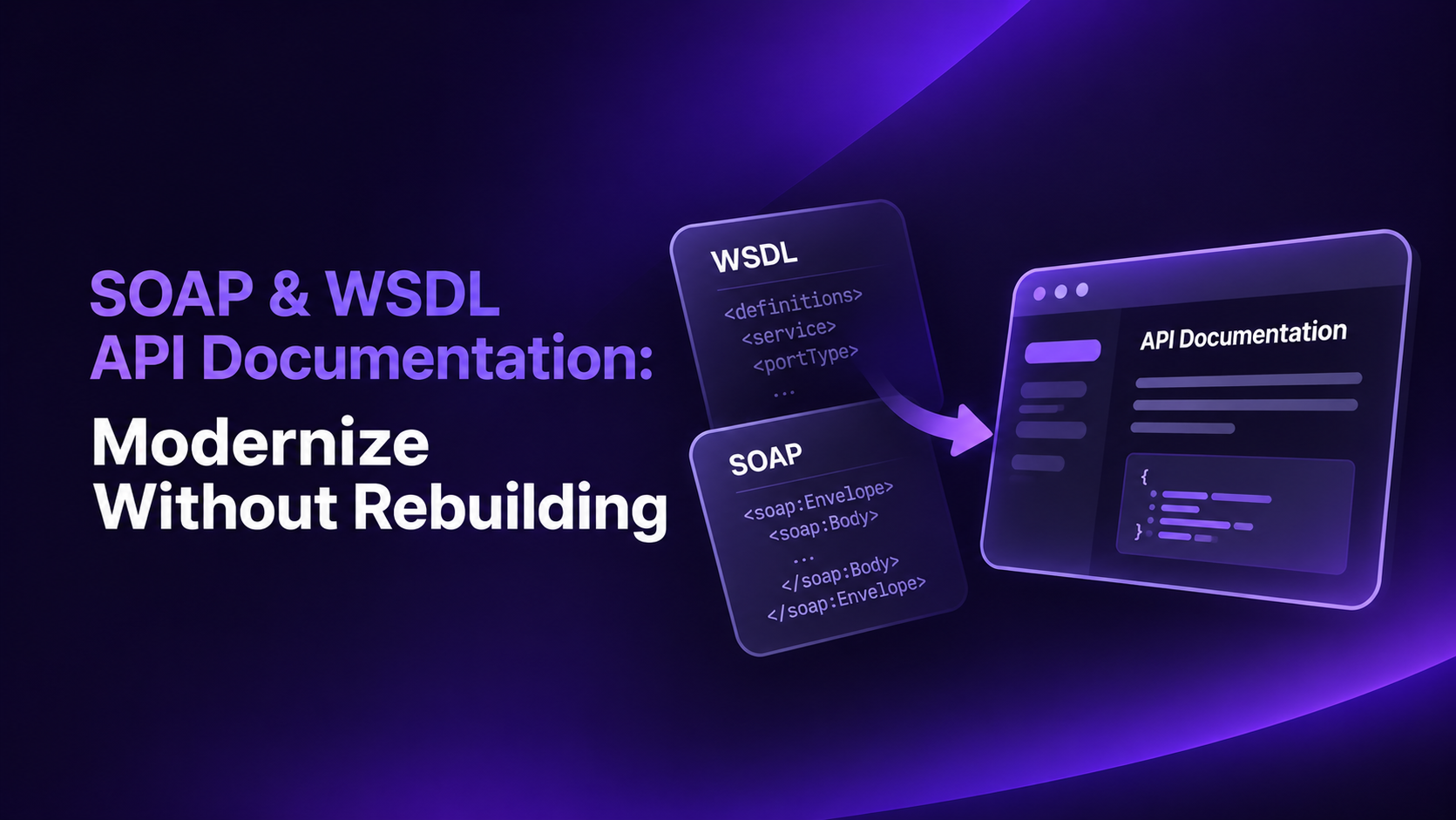
Theneo supports SOAP API documentation from WSDL and HAR, with automatic SOAP envelope rendering. That lets teams bring existing SOAP services into the same documentation environment they use for newer API styles.
What is SOAP API documentation?
SOAP API documentation explains how developers discover and call a SOAP service, including its operations, XML request and response structures, endpoints, authentication, action metadata, faults, examples, and versions.
SOAP is frequently described as a legacy technology. In practice, the better distinction is between the age of a protocol and the quality of the developer experience around it.
An established WSDL/XSD-backed SOAP API can still have a clear contract, predictable operations, strongly defined data types, stable authentication, useful examples, disciplined versioning, and excellent documentation. A REST API can be difficult to integrate with if its documentation is incomplete or inconsistent.
The useful question is whether a developer can understand what the service does, find the operation they need, construct a valid request, authenticate correctly, understand the response, diagnose faults, and know which version to use.
If the answer is no, rewriting SOAP as REST does not automatically solve the problem. Modernization can begin at the documentation layer.
What is WSDL and what does it contain?
WSDL is a machine-readable service contract that can describe data types, messages, operations, protocol bindings, service endpoints, and related service metadata. Many SOAP services use WSDL as their formal interface definition, often alongside XML Schema definitions for the data exchanged by the service.
That makes WSDL valuable as a source of truth. It does not make raw WSDL a good interface for developers.
Developers should not need to inspect XML to answer basic questions such as:
- Which operations does this service expose?
- What request does each operation expect?
- What response will it return?
- Which endpoint, binding, headers, and authentication method should I use?
A better documentation experience uses WSDL as structured input and presents the service in a human-readable API reference.
For SOAP specifically, Theneo accepts WSDL and HAR and automatically renders SOAP envelopes. The service itself does not need to change just because the documentation experience does.
How should SOAP operations be documented?
Developers usually arrive at documentation with a task in mind. They want to create a claim, retrieve an account, submit a payment, update a customer, or check eligibility.
That is why operations should be first-class navigation objects in SOAP documentation.
For each operation, useful documentation should make it easy to understand:
- What the operation does and when to use it.
- The endpoint, operation or action metadata, content type, and required headers.
- The request structure and required fields.
- The response structure and important return values.
- Authentication requirements and representative faults.
- A complete request and response example.
This gives SOAP documentation the same task-oriented structure developers expect from modern API references.
Make XML schemas readable
Enterprise SOAP APIs can have large XML schemas. Types reference other types, elements are nested several levels deep, namespaces multiply, and a request that looks small at the operation level may depend on definitions spread across several XSD files.
That structure is useful for machines. It can be difficult for humans to navigate directly.
Good SOAP documentation should help developers understand the hierarchy of a payload, distinguish required and optional fields, identify types, and follow nested structures without forcing them to manually trace every schema reference.
The goal is not to hide XML. The goal is to give developers a readable view of the same contract while keeping the underlying service definition available when they need it.
Show complete SOAP request and response examples
Examples are especially important for SOAP because a valid request often depends on more than the business fields inside the body.
A developer may need to get namespaces, envelope structure, headers, identifiers, action values, and nested XML exactly right.
A simplified SOAP 1.1 request might look like this:
<soapenv:Envelope xmlns:soapenv="http://schemas.xmlsoap.org/soap/envelope/">
  <soapenv:Header>
    ...
  </soapenv:Header>
  <soapenv:Body>
    ...
  </soapenv:Body>
</soapenv:Envelope>
The schema tells a developer what structures are valid. A realistic example shows how those structures are normally used.
That is why SOAP documentation should include representative requests and responses whenever possible, together with enough context to explain important headers, namespaces, and values.
Theneo's automatic SOAP envelope rendering helps teams present SOAP requests in a documentation experience built for developers rather than asking them to work from the WSDL alone.
How should SOAP faults be documented?
Happy-path documentation is not enough for enterprise integrations.
SOAP defines a structured Fault mechanism for communicating error information. WSDL can also describe faults associated with operations.
Documentation should go further than saying that a fault is possible. Developers need to understand what common failures mean and what to do next.
For important operations, document the faults a caller may encounter, representative fault payloads, stable codes or identifiers that can be handled programmatically, which failures indicate invalid input or authentication problems, which failures may be transient, and what remediation is expected from the caller.
A developer troubleshooting an integration should not need institutional knowledge to decode a SOAP Fault.
Treat authentication as documentation, not tribal knowledge
SOAP itself does not mandate one authentication model. Real deployments can use HTTP authentication, WS-Security mechanisms, certificates, tokens, API gateways, or organization-specific security layers.
That makes authentication documentation especially important.
Developers need to know where credentials belong, which headers are required, whether certificates are involved, how environments differ, what an authentication failure looks like, and how credentials should be rotated or refreshed when applicable.
Make multiple SOAP services feel like one API estate
Large SOAP deployments rarely consist of one tidy WSDL.
An enterprise may have separate services for customers, accounts, billing, identity, claims, inventory, orders, or internal business domains. Some services may be public, some partner-only, and some internal.
A modern developer portal should help teams organize those services by product, domain, or audience rather than exposing a directory of unrelated WSDL files.
Version the documentation as carefully as the service
Long-lived SOAP APIs often accumulate multiple active versions. That makes version clarity part of the developer experience.
Documentation should make it clear which version is current, which versions remain supported, what changed, whether a new WSDL is required, and what developers need to do before a deprecated version is retired.
An older protocol with a clear lifecycle is easier to integrate with than a newer API whose breaking changes are poorly communicated.
Can SOAP and REST documentation live in the same portal?
Yes. Most enterprise API estates are mixed.
One product may expose REST. Another team may use GraphQL. Internal systems may use gRPC. Event-driven workflows may rely on AsyncAPI or webhooks. A business-critical integration built years ago may still use SOAP.
That is normal.
The mistake is allowing the documentation experience to fragment along the same lines.
Developers should not need one portal for REST, another system for GraphQL, and a folder of WSDL files for SOAP.
Theneo supports multiple API styles, including REST, SOAP, GraphQL, gRPC, AsyncAPI, and webhooks. SOAP services can be imported from WSDL or HAR and documented in the same environment as newer APIs.
Instead of asking, "How quickly can we replace every SOAP API?", teams can first ask, "How do we give every API, including SOAP, the same quality of developer experience?"
The second can often happen without changing the production implementation.
Do you need to rewrite SOAP APIs to modernize them?
No. There are valid reasons to replace a SOAP service, but improving the developer experience does not automatically require rebuilding the backend.
The backend platform may be reaching end of life. Security requirements may have changed. A different interface may offer clear maintainability, performance, or adoption benefits.
Those are architectural decisions.
"Developers hate our documentation" is not, by itself, a reason to rewrite a working backend.
Teams can modernize in layers:
- Make every SOAP service discoverable in the API catalog.
- Generate readable operation and schema documentation from WSDL.
- Add realistic requests, responses, authentication guidance, and fault examples.
- Clarify environments, versions, lifecycle, and change communication.
- Rewrite or replace the backend only when the architecture itself requires it.
These layers do not need to move at the same speed.
A practical SOAP documentation checklist
Before calling a SOAP API legacy, audit the experience developers actually receive.
- Can developers quickly find the right service and operation?
- Can they understand request and response structures without manually tracing WSDL and XSD files?
- Are complete SOAP envelope examples available?
- Are authentication, headers, endpoints, and environments clearly documented?
- Are common SOAP faults explained with remediation guidance?
- Is the current version obvious, with older versions and deprecations clearly marked?
- Can SOAP documentation live alongside the rest of the API estate in the same developer portal?
If several answers are no, you may not have a SOAP problem. You may have a documentation problem.
Modernize the developer experience first
SOAP may never be the fashionable API architecture of 2027. It does not need to be.
Enterprise systems are full of technologies that remain valuable long after the industry's attention moves elsewhere.
The mistake is allowing an older protocol to justify an older developer experience.
A WSDL should not condemn developers to raw XML. A mature service should not disappear from an API catalog because it predates OpenAPI. And a modernization initiative should not require rebuilding a reliable production system before developers receive usable documentation.
Theneo supports SOAP API documentation from WSDL and HAR, with automatic SOAP envelope rendering, so teams can bring existing SOAP services into a modern documentation experience alongside REST, GraphQL, gRPC, AsyncAPI, webhooks, and other API styles.
Modernize the developer experience first. Rewrite the underlying service when the architecture actually requires it.
Import your WSDL into Theneo and start documenting your SOAP API.
Frequently Asked Questions
Does Theneo support SOAP API documentation?
Yes. Theneo supports SOAP API documentation from WSDL and HAR, with automatic SOAP envelope rendering.
Can Theneo import a WSDL file?
Yes. Theneo supports WSDL as an input for SOAP API documentation, so teams can turn an existing service definition into a more developer-friendly documentation experience.
Do I need to rewrite a SOAP API to modernize its documentation?
No. You can modernize discovery, documentation, examples, navigation, version guidance, and the developer portal without changing the underlying SOAP service.
What should good SOAP API documentation include?
Good SOAP documentation should explain operations, request and response structures, XML schemas, authentication, representative examples, SOAP faults, endpoints, environments, and version lifecycle.
Can SOAP, REST, and GraphQL documentation live in the same developer portal?
Yes. Theneo supports REST, SOAP, GraphQL, gRPC, AsyncAPI, and webhooks, allowing teams to document different API styles in one documentation environment.