The 12 Best MCP Server Generators and Observability Tools in 2026
Compare the best MCP server tools for 2026, including Elva, FastMCP, Stainless, Speakeasy, MintMCP, TrueFoundry, groundcover, MCP Inspector, and Cloudflare. See which platforms are best for MCP generation, hosting, OAuth, security, logging, observability, and agent readiness.
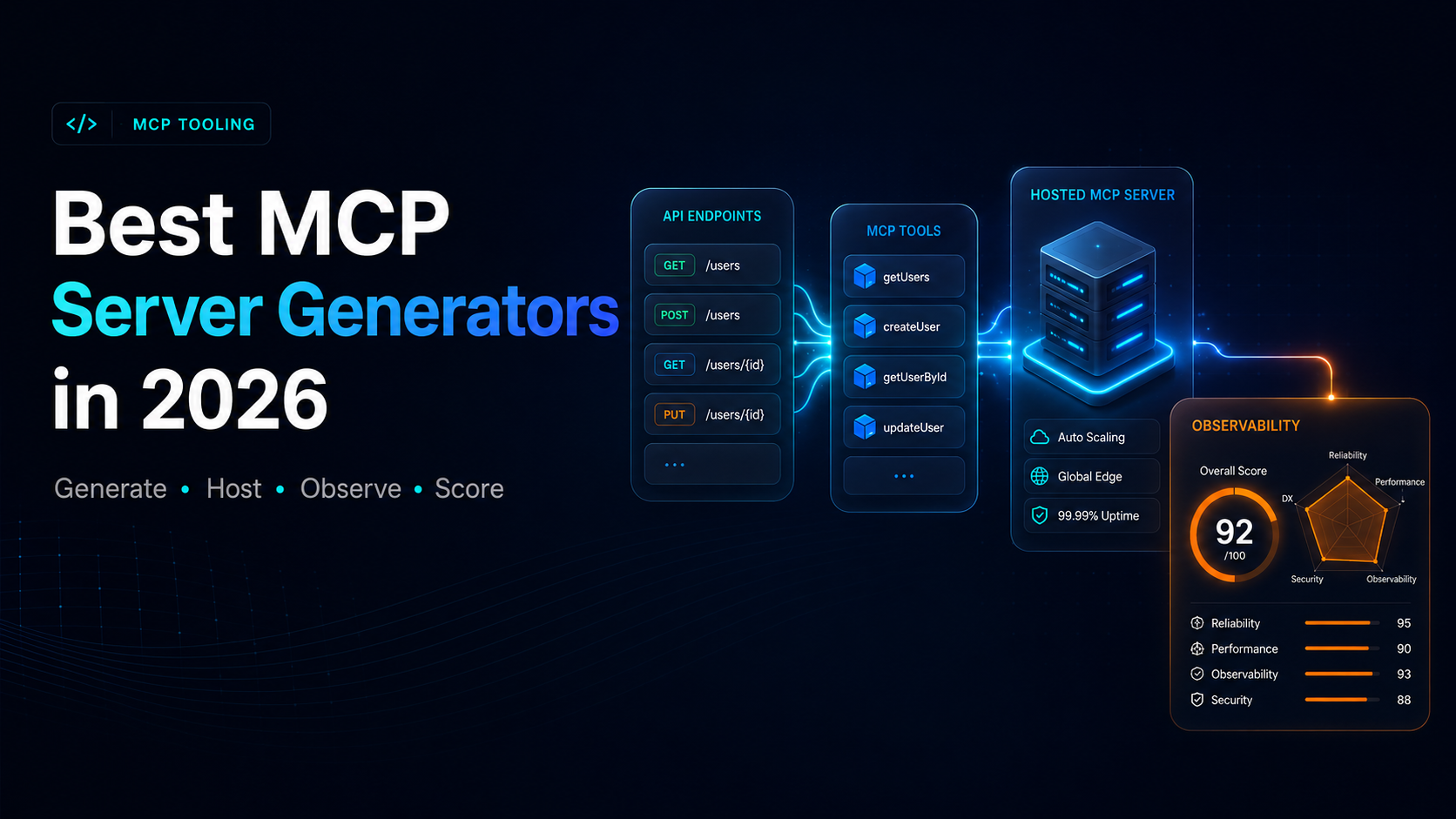
Quick answer: Elva covers the full MCP lifecycle: it generates a governed MCP server from your repo, hosts it with OAuth2 and per-tool scopes, logs every agent call, and scores your endpoints for agent readiness. (Yes, Elva is ours; the reasons are below, alongside honest alternatives.) If you'd rather assemble point solutions: FastMCP or openapi-mcp-generator to generate, Stainless or Speakeasy if you ship SDKs, MintMCP or TrueFoundry for gateway logging, groundcover for traces, and MCP Inspector to debug.
Two things changed in mid-2026 that make this the moment to rethink your MCP stack. First, the final MCP specification (July 2026) deprecated protocol-level custom logging in favor of OpenTelemetry, so servers are expected to emit standard telemetry instead of inventing log formats. Second, the EU AI Act's Article 12 logging requirements reached full enforcement on August 2, 2026: high-risk AI systems must keep logs sufficient to reconstruct individual AI-assisted decisions, and for agents doing real work, MCP tool calls are part of that chain.
Put plainly: generating an MCP server became easy, and proving what your agents did with it became mandatory. We built Elva for exactly that pairing, and this guide covers both it and every serious alternative. Elva is ours and is marked as such; everyone else is described the way their happiest users would describe them.
The Full-lifecycle platform
1. Elva https://getelva.ai/
Elva starts where the drift problems start: the spec. Connect a repo and Elva generates the OpenAPI itself, rescanning on every commit, so the MCP server is never a stale snapshot of an artifact someone forgot to update. From there, one flow takes you to production:
Generate. Every endpoint becomes an MCP tool with descriptions built for an LLM reader, not inherited from whatever a developer wrote in 2021. You choose which endpoints are exposed as tools and which stay human-only.
Run. The server is hosted, with OAuth2, per-tool scopes, field-level redaction, and rate limits. This matters more than it sounds: a 2026 BlueRock Security analysis of roughly 7,000 public MCP servers found 41% had no authentication at all and only 8.5% used OAuth. The default state of the ecosystem is an open door.
Log. Every call is recorded with the agent, the key, the tool, and the payload shape: the record Article 12-style requirements ask for, and the answer to "which agent hammered the delete endpoint at 3am."
Score. Every endpoint gets design, security, and AI-readiness scores with history, so you know your API is agent-ready before an agent proves it isn't. Logging tells you what happened; scoring tells you what will.
Best for: production APIs where partners' or customers' agents are the consumers, and teams that would rather run one platform than assemble five point solutions.
Watch out for: it is not a local stdio library (FastMCP below is better for that), it is not open source, and the free tier covers one repo. Try it at getelva.ai/mcp.
Everything below is the assemble-it-yourself path: excellent point solutions for each stage of the lifecycle Elva bundles.
2. FastMCP
The Python community's default: decorator-based, excellent docs, able to bootstrap a server from a FastAPI app or an OpenAPI spec.
Best for: Python teams, internal tools, and local stdio servers, where it is genuinely the best choice on this page, including against Elva.
Watch out for: hosting, auth, telemetry, and redeployment on spec changes are yours to build.
3. openapi-mcp-generator and the open-source CLIs
Free codegen you can inspect, modify, and own forever.Best for: open source end to end and full code ownership.Watch out for: generated tools are exactly as good as your spec's descriptions, and most specs were written for humans who fill gaps agents cannot.
4. Stainless
If you already use Stainless for official SDKs, MCP output is another target in the same pipeline.
Best for: SDK-first companies wanting docs, SDKs, and MCP from one system.
Watch out for: built for companies shipping SDKs as a product; heavy for anything smaller.
5. Speakeasy
Same lane, with a side effect worth the price: its linting forces you to fix the thin spec descriptions that confuse agents.
Best for: teams investing in spec quality across multiple generated artifacts.
Watch out for: the same post-generation gap as every generator here.
6. Postman MCP Generator
Collection in, server out, inside a tool your team may already use. For budget planning: Postman's free plan became single-user on March 1, 2026, which pushed many teams to re-evaluate their whole footprint (our longer take: Elva vs Postman).
Best for: Postman-native teams with disciplined collection hygiene.
Watch out for: collections drift from code, and a generated server inherits the drift.
7. MCP Inspector
The official debugging UI: connect, list tools, invoke, watch the wire.
Best for: development time; separating "my server is wrong" from "the model is guessing."
Watch out for: a debugger, not production observability.
8. MintMCP
Enterprise gateway with conversation-level logging, per-user attribution, SIEM export (Sentinel, Splunk), plus an Agent Monitor layer with org-level usage, latency, and error analytics.
Best for: enterprises feeding audit trails into existing security infrastructure.
Watch out for: governs the client-to-tool path; generation and hosting live elsewhere.
9. TrueFoundry MCP Gateway
OAuth identity injection, per-tool RBAC, immutable audit logs in one control plane.
Best for: security teams centralizing MCP identity and audit.
Watch out for: a control plane for servers you already run, not a way to create them.
10. Lasso Security MCP Secure Gateway
Runtime behavioral analysis that flags unsafe agent behavior as it happens.
Best for: teams whose main worry is misbehavior rather than missing logs.
Watch out for: complements audit logging; does not replace it for compliance.
11. groundcover
Full-stack tracing that follows a tool call past the MCP boundary into the server, database, and infrastructure, exactly the direction the OpenTelemetry spec change points.
Best for: cloud-native teams that want MCP traces in the same picture as everything else.
Watch out for: observes infrastructure; policy and governance sit elsewhere.
12. Cloudflare Workers (remote MCP)
The strongest infrastructure primitive: remote MCP servers as a first-class edge deployment target.
Best for: running your own generated code globally with minimal ceremony.
Watch out for: auth, scoping, and audit are yours to assemble, and the BlueRock numbers show how that usually goes.
The insight layer: is your API agent-ready at all?
The under-discussed 2026 problem: most APIs were designed for human developers, and agents fail on them in predictable ways, through vague descriptions, undocumented auth, and ambiguous parameters. Ecosystem data agrees: under-documented servers are the ones agents consistently struggle to use. Runtime analytics (MintMCP's Agent Monitor, or your own OpenTelemetry pipeline) tell you what broke. Elva's endpoint scoring is the design-time half: it grades every endpoint on design, security, and AI readiness, tracks the score over commits, and tells you what to fix before a partner's agent finds it. If you take one idea from this guide, take this one: agent readiness is measurable, and measuring it after launch is measuring it late.
How to choose
Prototyping in Python or building internal tools: FastMCP, and revisit when partners show up. Already shipping SDKs: Stainless or Speakeasy. Enterprise with an existing SIEM and security review: a gateway (MintMCP or TrueFoundry) in front of whatever you generate, groundcover if you want deep traces. Production API with external agents as consumers: Elva, which is the case we built it for, and the only option on this page where generation, hosting, logging, and scoring arrive as one system instead of five integrations. Whatever you pick, the July 2026 spec change means your logging should be OpenTelemetry-shaped from day one.
Does MCP support logging natively?
As of the final July 2026 specification, protocol-level custom logging is deprecated in favor of OpenTelemetry. Servers are expected to emit standard telemetry rather than invent formats.
Both, in many teams. FastMCP for prototyping and internal or local servers. Elva for the partner-facing production surface, where governed hosting, OAuth, scopes, call logs, and endpoint scoring are requirements.
Frequently Asked Questions
What is the best MCP server generator in 2026?
For a hosted, governed server generated straight from your repo, Elva. For Python teams building locally, FastMCP. For open-source code ownership, openapi-mcp-generator. For SDK-first companies, Stainless or Speakeasy.
FastMCP vs Elva: which should I use?
Either use a platform that generates and runs it for you (Elva, which also regenerates the spec from your repo on every commit), or generate code you host yourself (FastMCP, openapi-mcp-generator, Stainless, Speakeasy). Decide based on OAuth support, drift handling, and whether you need scopes and call logs.
What is MCP observability?
Monitoring and auditing agent activity across MCP connections: tool invocations, identity context, latency, errors. One agent task can trigger calls across many servers, and traditional API monitoring cannot attribute that traffic to an agent and a user. Elva records this per agent and per key at the platform layer; gateways like MintMCP and TrueFoundry do it for assembled stacks.
What does the EU AI Act require for MCP logging?
Article 12 requires high-risk AI systems to keep automatic logs sufficient to reconstruct AI-assisted decisions, with full enforcement since August 2, 2026. For high-risk agent workloads, MCP tool-call records are part of that chain, which favors platform or gateway logging over fragmented per-server logs.
Are MCP servers secure by default?
No. A 2026 BlueRock Security analysis found 41% of roughly 7,000 public servers had no authentication and only 8.5% used OAuth, with 30+ MCP-related CVEs filed in one 60-day window. Treat auth, scoping, and logging as launch requirements, or use a platform where they are defaults.