API Documentation Maintenance Checklist: Weekly, Release, and Quarterly Tasks
A practical API documentation maintenance checklist for weekly reviews, every release, and quarterly audits, with human review and automation guidance.
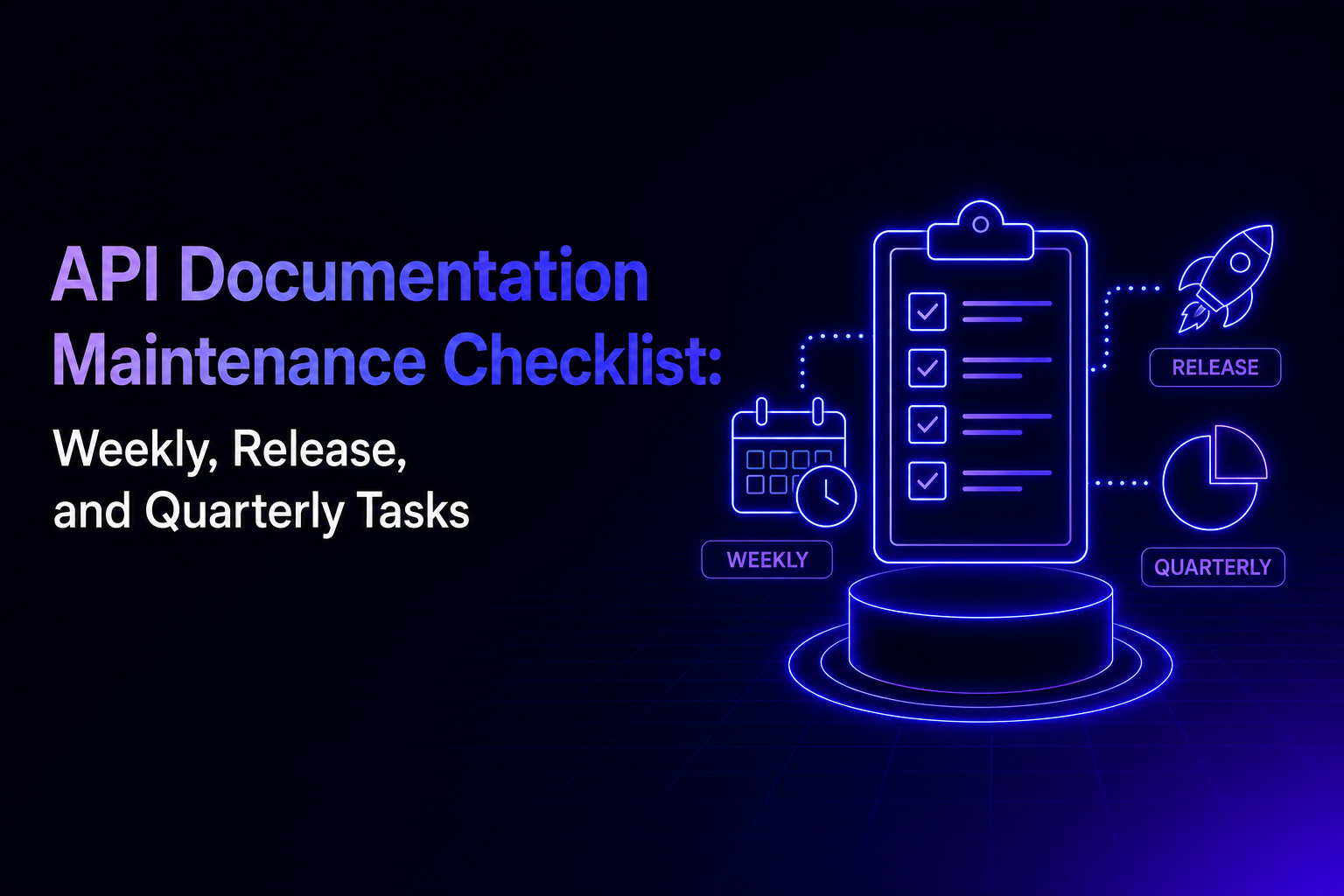
An API documentation maintenance checklist is a recurring set of checks that keeps published docs aligned with the API developers actually use. The most practical cadence is simple: review usage and feedback every week, validate every release before it ships, and audit structure, ownership, and automation every quarter.
Automation can detect changes and reduce repetitive work. It cannot decide whether an example teaches the right workflow, whether a migration warning is prominent enough, or whether an AI-generated description is accurate in context. Those decisions still need accountable human review.
API documentation maintenance checklist at a glance
- Weekly: review failed searches, reader feedback, support questions, high-traffic pages, broken links, and recently edited content.
- For every release: compare the API change with the reference, examples, authentication guidance, errors, changelog, and migration instructions before publishing.
- Quarterly: audit information architecture, ownership, stale pages, access controls, automation, analytics, exports, and recovery procedures.
This cadence turns documentation maintenance from an occasional cleanup into an operating process. Product managers can own user impact and priorities, engineers can verify technical behavior, and writers can protect clarity and consistency.
Why API documentation needs scheduled maintenance
API documentation drifts when the production API, source specification, examples, guides, and release communication change on different schedules. A technically valid OpenAPI file may still leave users without a realistic request example, a useful error explanation, or the context required to choose the correct endpoint.
The problem becomes more visible when AI systems use the same material. An AI answer can only work with the content it retrieves. Missing prerequisites, conflicting versions, ambiguous parameter descriptions, and stale examples can produce confident but incomplete answers. AI-generated documentation should therefore be treated as a proposal that requires review, not an automatic source of truth.
Theneo supports specification imports, hand-written guides, changelogs, search, feedback, and review workflows in one documentation environment. Its documentation also describes Markdown and CLI workflows for teams that keep content in version control. The platform can reduce coordination work, but accuracy still depends on a clear maintenance owner and review cadence.
What should you check every week?
The weekly review should focus on signals that reveal where readers are confused right now. Keep it short enough that the team can repeat it consistently.
1. Review search queries and unanswered questions
- Look for repeated searches that return weak or no results.
- Group different phrases that express the same task or problem.
- Check whether the answer exists under terminology readers would not know.
- Add a guide, example, synonym, or cross-link when the same gap appears repeatedly.
Theneo's documentation analytics includes AI search history, page activity, and section feedback. These are leading indicators of a content gap, not proof that visibility or adoption has improved. Track what users asked, what the team changed, and whether the same question continues to appear.
2. Triage reader feedback and support questions
- Assign every actionable comment to an owner.
- Separate factual errors from requests for more explanation.
- Compare support tickets with documentation feedback to find repeated friction.
- Close the loop after an update so the same issue is not investigated twice.
A low-rated page does not always need more content. It may need a clearer prerequisite, a working example, a better title, or a direct link to the next step.
3. Check recently changed and high-use pages
- Verify links, code blocks, sample payloads, and downloadable files.
- Test the main happy-path request from a clean environment.
- Confirm version labels and base URLs.
- Check that authentication examples do not expose secrets or obsolete flows.
- Make sure deprecated behavior is visibly labeled.
Prioritize pages that support onboarding, authentication, billing, and common integration flows. A small error on a high-use page usually creates more user impact than a larger issue in a rarely visited reference section.
What should you check for every API release?
A release review connects the change in the API to every place a developer may encounter it. Run this checklist before the release is considered complete.
1. Classify the change
- Is it additive, behavioral, deprecated, or breaking?
- Which versions and environments are affected?
- Does it change authentication, permissions, rate limits, schemas, or errors?
- Which user journeys depend on the changed behavior?
The classification determines the documentation response. A new optional field may require a reference update and example. A changed authentication flow needs a migration guide, release note, updated quickstart, and prominent warning.
2. Validate the source specification
- Confirm endpoint paths, methods, operation names, and tags.
- Check parameter types, required fields, defaults, and constraints.
- Verify request and response schemas against real behavior.
- Add realistic examples for success and common failure cases.
- Document error codes and recovery steps.
Specification-driven updates reduce manual copying, but an imported schema is not the entire developer experience. Human reviewers should still confirm intent, examples, sequencing, and task-level guidance.
3. Update the surrounding guidance
- Revise quickstarts, tutorials, SDK examples, and troubleshooting pages.
- Update navigation and cross-links when a new workflow is introduced.
- Add a migration path for breaking or deprecated behavior.
- Confirm that code samples use current dependencies and syntax.
- Make release timing and effective dates explicit.
4. Review before publication
Use a branch or staged workflow so reviewers can compare the proposed change with the live documentation. Theneo's documentation review workflow supports branches, rendered previews, comments, approvals, and side-by-side differences. The goal is not simply to add a gate. It is to let each reviewer answer a specific question:
- Engineering: Is the behavior technically correct?
- Product: Does the content reflect the intended user experience and release scope?
- Documentation: Can a reader understand and complete the task?
- Security or compliance: Are access, privacy, and disclosure requirements satisfied?
5. Publish and verify the live result
- Open the live page after publication.
- Test navigation, anchors, search, and interactive requests.
- Confirm the changelog and release note link to the relevant guide.
- Check that the intended audience can access the content.
- Record the owner and publication date.
Theneo's GitHub Actions guidance allows teams to choose automatic publishing or a manual review step. High-risk changes should favor review before publication. Lower-risk, specification-only updates may be automated when validation and rollback controls are mature.
What should you audit every quarter?
The quarterly audit looks beyond individual pages. It tests whether the documentation system still matches the product, audience, and organization.
1. Audit information architecture
- Can a new developer move from overview to first successful request without guessing?
- Are guides organized around tasks rather than internal team structure?
- Are API references, tutorials, changelogs, and troubleshooting pages clearly connected?
- Do old versions and deprecated sections remain easy to distinguish?
2. Assign ownership and service levels
- Name an owner for every critical documentation area.
- Define who approves technical, product, and editorial changes.
- Set a response target for factual errors and broken onboarding flows.
- Escalate pages with no active owner.
Ownership is an accuracy control. Without it, analytics can identify a problem but no one is accountable for resolving it.
3. Find stale and redundant content
- Review pages with old examples, dependencies, screenshots, or version references.
- Consolidate competing pages that answer the same question.
- Redirect removed URLs where appropriate.
- Archive obsolete material instead of leaving contradictory instructions live.
4. Test automation and rollback
- Confirm imports and CI/CD jobs still run with current credentials.
- Review merge strategies so generated updates do not overwrite curated guidance.
- Test preview, approval, publish, and rollback paths.
- Export a current copy of critical documentation and verify that it can be restored.
Portability and recovery reduce vendor lock-in risk. Theneo supports Markdown export and CLI workflows, which lets teams keep a versioned copy of documentation outside the publishing interface.
5. Review AI-assisted workflows
- Sample generated descriptions and answers for factual accuracy.
- Check whether retrieval selects the correct product, version, and audience context.
- Remove conflicting or duplicated source material that creates noisy answers.
- Require human approval for changes affecting authentication, security, billing, or breaking behavior.
AI accuracy is not a one-time configuration. Models, source content, and user questions change. Sampled review is a leading quality control, while fewer repeated failures and successful task completion are stronger outcome signals.
Who should own API documentation maintenance?
A product manager is often the best process owner because documentation quality crosses product behavior, release timing, and user experience. Ownership should still be shared:
- Product managers prioritize gaps and connect content to releases and user journeys.
- Engineers verify schemas, examples, errors, and runtime behavior.
- Technical writers maintain structure, terminology, clarity, and consistency.
- Support and developer relations bring recurring questions and adoption friction into the backlog.
- Security and compliance review sensitive workflows and access requirements.
For a smaller team, one person may cover several roles. The important part is that each check has a named owner and a visible completion record.
How do you know the checklist is working?
Do not judge a maintenance program by the number of pages edited. Track whether the system is operating and whether user friction changes.
- Leading indicators: checklist completion, review turnaround, unresolved feedback, broken-link count, stale-page count, and repeated failed searches.
- Lagging outcomes: onboarding completion, support volume tied to documentation, search success, developer task completion, organic visibility, and conversion where grounded attribution exists.
A few days of cleaner analytics do not prove that documentation moved the needle. Look for sustained patterns and document what was tracked separately from what demonstrably improved.
Start with one repeatable cycle
Begin with a 30-minute weekly review, attach the release checklist to your shipping process, and schedule the quarterly audit now. Keep the first version small enough to complete. Add controls only when a real failure mode justifies them.
Theneo brings API references, guides, changelogs, feedback, analytics, automation, and human review into one workflow. Explore Theneo to build a maintenance process where automation proposes changes and accountable reviewers decide what reaches developers.
Frequently Asked Questions
How often should API documentation be reviewed?
Review usage signals and feedback weekly, validate documentation for every API release, and run a broader ownership and structure audit quarterly.
Can API documentation maintenance be fully automated?
No. Automation can detect changes and publish approved updates, but human review is needed for intent, accuracy, examples, migration guidance, and risk-sensitive changes.
What is the most important release check?
Verify that published documentation matches real API behavior, including authentication, examples, errors, versions, and migration guidance.
How should teams maintain AI-generated API documentation?
Treat generated content as a draft, sample it for accuracy, verify retrieval context, remove conflicting sources, and require human approval for high-risk changes.
Who owns API documentation maintenance?
Product commonly owns the process, engineering verifies behavior, writers own clarity, and support or developer relations supplies recurring user questions.