How to Measure AI Agent Traffic to API Documentation Without Overclaiming
Learn how to measure AI crawler requests, user-triggered agent fetches, AI referrals, and downstream outcomes without confusing visibility signals with business impact.
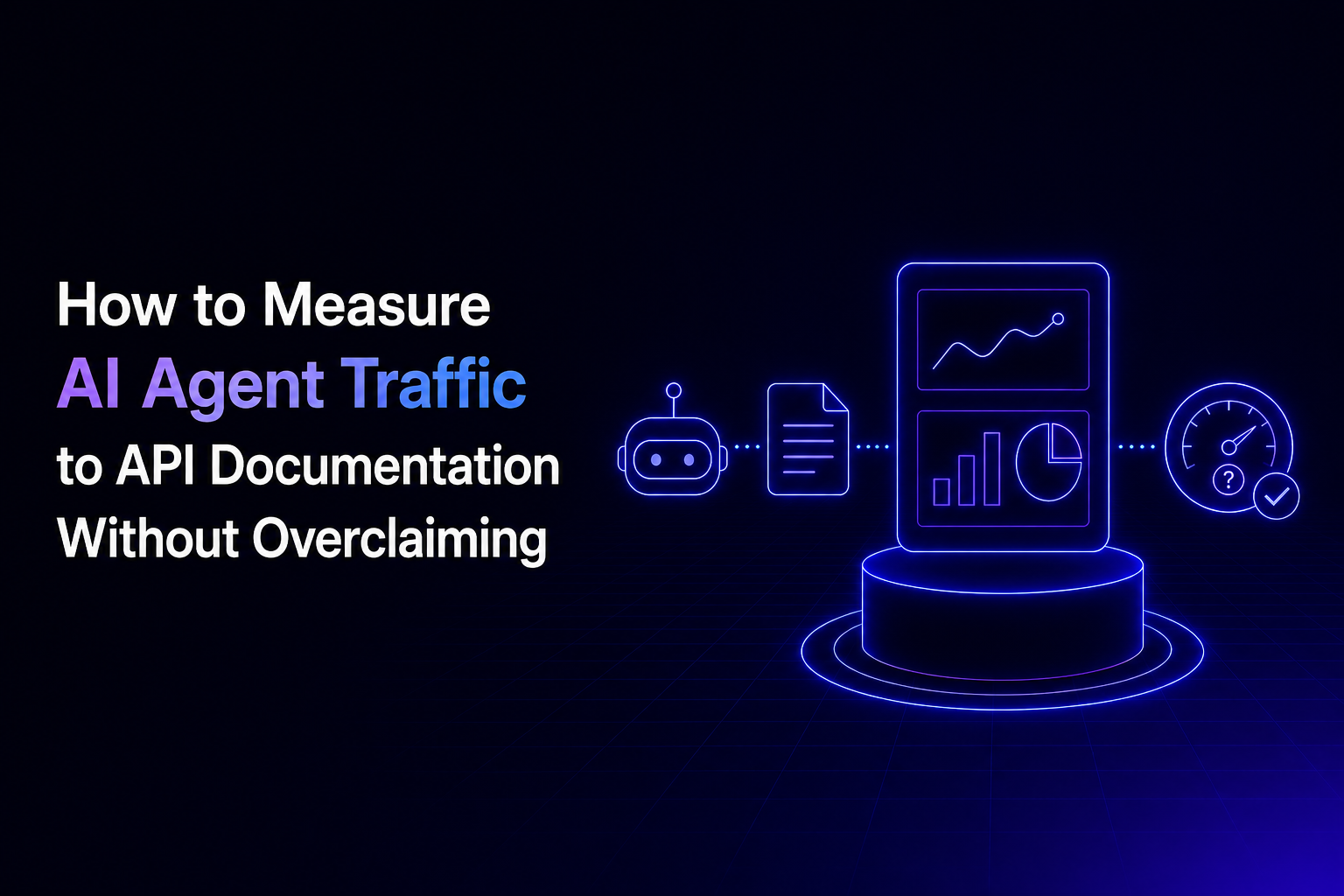
How to Measure AI Agent Traffic to API Documentation
AI agent traffic to API documentation is not one metric. It is a set of observable signals across crawler requests, user-triggered agent fetches, human referrals from AI products, and downstream API activity. Each signal answers a different question, and none proves the full journey by itself.
For product managers, the useful goal is not to produce a single AI traffic number. It is to build a measurement model that separates what was observed from what was attributed or inferred. That distinction prevents a crawler spike from being reported as adoption, a referral session from being treated as a citation, or an API call from being credited to an agent without evidence.
What counts as AI agent traffic to API documentation?
Start by classifying activity into four traffic types. This makes the dashboard more honest and the investigation more actionable.
- Training or model-development crawlers. Automated systems may collect public content for model development. Their requests show that content was fetched, not that it will appear in an answer.
- Search and retrieval crawlers. These systems index or retrieve pages for search and answer experiences. They are closer to discovery, but still do not prove selection or citation.
- User-triggered agent fetches. An assistant or agent may request a document while answering a user's prompt or completing a task. This is a stronger usage signal, especially when the requester can be verified.
- Human referrals and downstream actions. A person may click from an AI product into the docs, create an account, generate credentials, or make API calls. These are outcome signals, but attribution can still be incomplete.
This taxonomy aligns with how modern bot-management systems distinguish search, AI assistant, training, and other automated traffic categories. Cloudflare, for example, separates verified bots by purpose and documents stronger identity methods such as Web Bot Auth, stable IP ranges, and reverse DNS. A claimed user-agent string alone is weaker evidence because it can be copied.
Which data sources should product managers combine?
No single tool sees the whole path. A practical measurement stack joins several sources with different strengths.
1. CDN and server logs
Logs are the primary record of machine requests. Capture the timestamp, requested URL, user agent, source IP or verified bot identity, HTTP status, response bytes, cache status, and request ID.
For documentation, pay particular attention to requests for HTML pages, OpenAPI files, llms.txt, llms-full.txt, Markdown exports, and other machine-readable endpoints.
Logs answer: Which resources were requested? By whom, with what confidence? Did the request succeed?
They do not answer whether the content was used in a generated response.
2. Web analytics
Analytics tools are useful for human sessions arriving from AI products. Track source, medium, referrer, landing page, engagement, and conversions. Keep a maintained mapping of known AI referrer domains, and preserve UTMs on campaigns or links you control.
Do not assume every AI-originated session will be labeled correctly. Google Analytics documents that direct traffic can mean there was no clear referral source, including cases where referrer information or campaign parameters were missing. Treat direct traffic as unattributed, not as proof that AI was absent.
3. Documentation platform analytics
Page-level documentation analytics can show which guides, references, and onboarding pages receive traffic. When a platform reports user-agent information, it can help separate likely browsers from known AI assistants.
ReadMe, for example, added a User Agent column to page-view metrics that can identify a browser or AI assistant. This is useful context, but the same verification caveat applies.
4. Agent and MCP telemetry
If documentation is exposed through an MCP server or another agent-facing interface, record tool discovery, tool calls, requested resources, latency, status, authorization scope, and errors.
Avoid logging secrets or full sensitive payloads. MCP telemetry is often a clearer signal of task-oriented agent usage than a generic page view because it records an explicit tool interaction.
5. Downstream product and API events
The strongest commercial signals happen after documentation consumption. Connect documentation activity to account creation, key generation, sandbox activation, first successful API call, repeated API usage, and qualified opportunities only when the identifiers and consent model support it.
Scoped tokens, request IDs, or controlled agent integrations can create defensible links. Without those links, report correlation rather than attribution.
How should AI traffic be classified?
Build a classification table before building charts. It keeps teams from mixing signals that have different meanings.
Training crawler
- Primary evidence: Verified crawler request in logs
- Supports: Content was fetched
- Does not prove: Inclusion, citation, or referral
Search or retrieval crawler
- Primary evidence: Verified request plus successful response
- Supports: Content was available for indexing or retrieval
- Does not prove: Selection in an answer
User-triggered agent
- Primary evidence: Verified assistant fetch or tool call
- Supports: Documentation was retrieved during a task
- Does not prove: Correct interpretation or business impact
AI referral
- Primary evidence: Referrer or campaign-tagged session
- Supports: A user arrived from an AI product
- Does not prove: Which answer or passage caused the click
Downstream outcome
- Primary evidence: Linked signup, token, integration, or API event
- Supports: A measurable product action occurred
- Does not prove: Agent influence without a reliable linking identifier
What should an AI documentation dashboard report?
A useful weekly view combines reachability, retrieval, referrals, and outcomes. Keep raw counts separate from rates, and attach a confidence label to every metric.
- Machine reachability: Successful and failed requests to documentation and machine-readable files, split by verified traffic class.
- Coverage: Unique documentation URLs fetched, response status distribution, and important pages never requested.
- User-triggered retrieval: Verified agent fetches or tool calls, resources requested, and completion or error rates.
- AI referrals: Sessions by known referrer, landing page, engagement, and conversion events.
- Downstream outcomes: Linked signups, key generations, first API calls, integrations, or other approved product events.
Use three evidence labels:
- Observed: The event appears directly in a trusted log or analytics record.
- Attributed: The event is connected to a source through a controlled identifier, verified referrer, or scoped integration.
- Inferred: The connection is plausible but not directly established.
For example, a verified agent fetched /authentication is observed. A signup carrying a controlled campaign parameter from an AI referral is attributed. A same-day increase in signups after crawler activity is only inferred.
Which metrics are leading indicators, and which are outcomes?
Leading indicators tell you whether documentation is available and usable by machines. They include successful crawler access, coverage of priority pages, parseable OpenAPI files, requests to llms.txt or Markdown exports, user-triggered fetches, and low error rates. These are valuable operational signals.
Lagging outcomes include verified citations, referral sessions, signups, completed integrations, API usage, retention, and pipeline. These are closer to business value, but they typically take longer to accumulate and are harder to attribute.
Do not claim that a few days of crawler activity improved revenue or AI visibility. AI answer systems are sampled and non-deterministic. Measure a stable set of priority prompts over time, record whether Theneo appears and is cited, and treat those observations as a sample rather than an exact share of voice.
How can teams avoid overclaiming?
Apply these controls to every report:
- Separate bots from referrals. A bot request is not a human visit.
- Separate retrieval from citation. A successful fetch does not show that the content appeared in an answer.
- Verify identities where possible. Prefer cryptographic verification, documented IP ranges, or reverse DNS over a user-agent claim.
- Report unattributed traffic honestly. Do not reclassify direct traffic as AI without supporting evidence.
- Keep prompt monitoring sampled. Repeat prompts across time and environments, and disclose the method.
- Connect outcomes only with defensible identifiers. Otherwise describe the relationship as correlation.
Which AI SEO tactics are supported by evidence?
Machine-readable delivery and reliable parsing are proven. Well-formed HTML, accessible OpenAPI definitions, clean Markdown exports, and successful responses make documentation easier for automated systems to retrieve and process.
Greater availability leading to more AI citations is plausible, unconfirmed. Retrieval is a prerequisite for many systems, but availability alone does not guarantee selection, accurate synthesis, or citation.
A deterministic AI visibility score is contested. Rankings and citations vary by prompt, model, location, account state, and time. A single exact score can conceal more uncertainty than it resolves.
How should product managers implement this measurement model?
Start with a small, auditable system:
- Define the priority documentation journeys and the AI prompts that matter to buyers and developers.
- Inventory the available logs, analytics, documentation metrics, MCP telemetry, and downstream events.
- Create the four traffic classes and an allowlist of known, verified identities and referrers.
- Instrument machine-readable documentation endpoints, including the files described in Theneo's guide to configuring llms-full.txt and Markdown export.
- Build a weekly dashboard with observed, attributed, and inferred labels.
- Review anomalies manually before publishing claims.
- Evaluate lagging outcomes monthly, after enough data has accumulated.
Teams that are still designing discovery for agents can also review Theneo's guide to llms.txt, MCP, and API discovery.
The objective is not to maximize a bot count. It is to make API knowledge reliably retrievable, measure the resulting activity with appropriate confidence, and connect it to product outcomes only when the evidence supports the connection.
The practical standard: report the evidence, then the limitation
The most credible AI traffic report pairs every number with what it means and what it cannot establish.
"A verified user-triggered assistant fetched 240 documentation resources with a 98% success rate" is useful.
"AI agents generated 240 documentation engagements" is not, unless engagement has been explicitly defined and verified.
That discipline gives product managers a measurement system they can improve over time. It also makes the results more useful to engineering, marketing, and leadership because everyone can see where the evidence is direct, where attribution is controlled, and where uncertainty remains.
Frequently Asked Questions
What counts as AI agent traffic to API documentation?
AI agent traffic includes training crawlers, search and retrieval crawlers, user-triggered assistant fetches, human referrals from AI products, and downstream agent or API activity. These signals should be reported separately because each supports a different conclusion.
Can user-agent strings reliably identify AI agents?
Not by themselves. User-agent strings can be copied or spoofed. Stronger identification uses verified bot programs, cryptographic Web Bot Auth, documented IP ranges, or reverse DNS, combined with request behavior and logs.
Does crawler traffic prove an AI tool cited our documentation?
No. A crawler request proves that content was fetched. It does not prove that the content was indexed, selected, quoted, cited, or shown to a user. Citation monitoring requires separate, sampled testing of priority prompts.
How should GA4 AI referrals be measured?
Track known AI referrer domains, source and medium, landing pages, engagement, and conversions. Preserve campaign parameters on links you control. Treat direct traffic as unattributed because missing referrer data can cause AI-originated sessions to appear as direct.
Which AI documentation metrics should product managers report?
Report machine reachability, documentation coverage, verified user-triggered retrieval, AI referrals, and linked downstream outcomes. Label each metric as observed, attributed, or inferred, and state what the evidence does not prove.