Why API Specs Break AI Agents and How to Fix Them Before MCP Launch
A technically valid OpenAPI spec still breaks AI agents when it's missing intent, examples, auth context, and error recovery. Here's how to make your API spec MCP-ready — step by step.
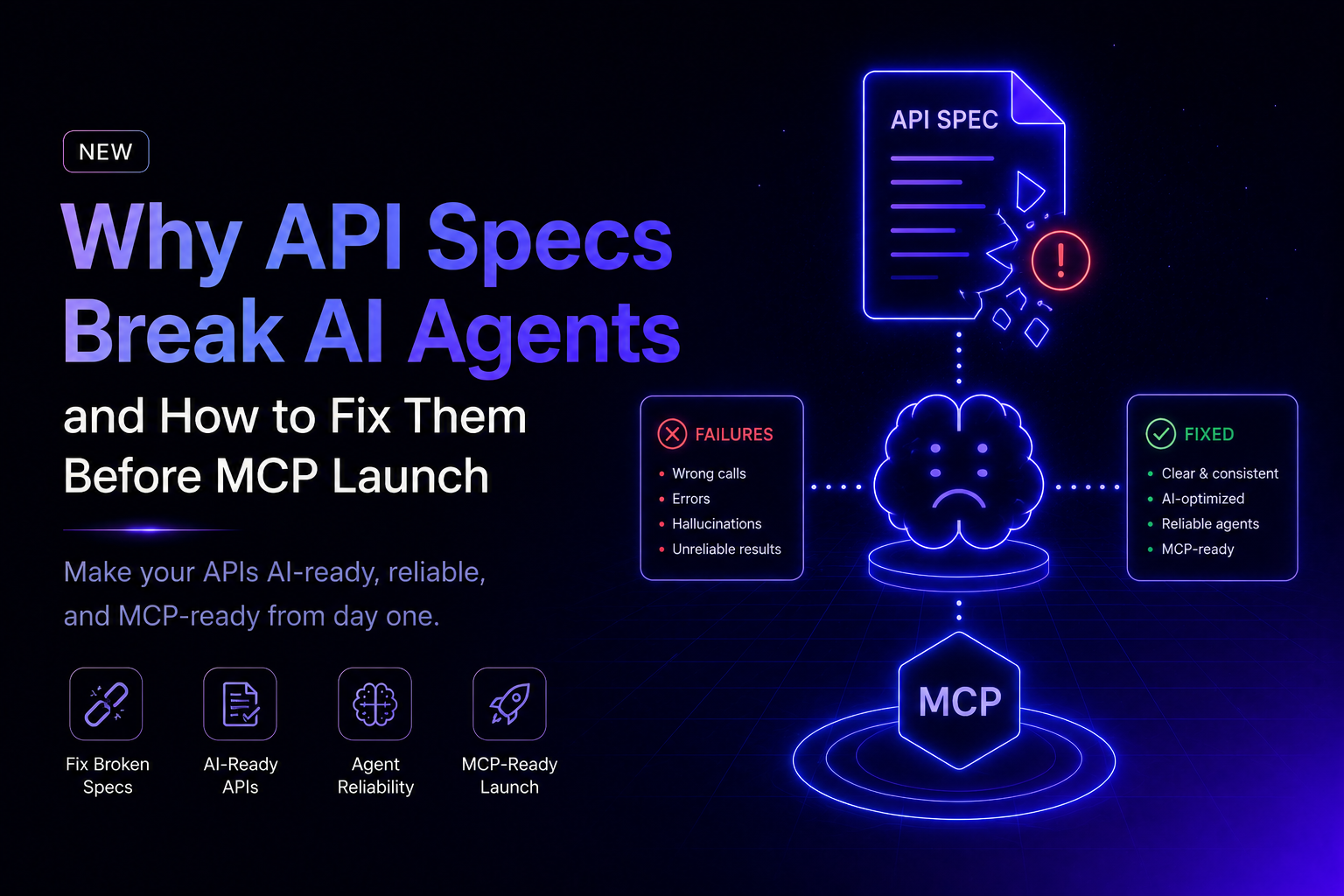
Turning an OpenAPI spec into an MCP server is easy. Making that server actually usable by AI agents is the hard part, and it's where most launches quietly fail. An OpenAPI file can pass validation and still leave an agent guessing what a parameter means, which auth flow applies, whether an endpoint is safe to call, or how to recover from an error. The Model Context Protocol gives AI applications a standard way to connect to external tools, data, and workflows. But MCP doesn't make a vague spec smarter. It just gives the agent a cleaner path to the same bad assumptions. This guide walks through the six spec-quality gaps that break agents, and how to close each one before you expose your API through MCP.
What does it mean for an API spec to be "agent-ready"?
An agent-ready spec is one an AI agent can act on without human context. Human developers fill gaps automatically: they see customer_id, check a dashboard, read a support thread, and infer whether the value is an internal ID, an external account ID, or a tenant-scoped identifier. Agents can't do that. They only have what's written in the spec, the guide, or the machine-readable context you expose. If the meaning isn't there, the agent may call the wrong endpoint, pass the wrong value, retry dangerously, or generate integration code that looks plausible and fails in production.
So "agent-ready" isn't about adding more documentation. It's about making the contract explicit: intent, constraints, examples, auth, errors, and freshness all stated where the agent will look for them.
Why do AI agents fail when using OpenAPI documentation?
AI agents fail on API documentation for five recurring reasons: missing intent, weak examples, incomplete auth context, unclear errors, and stale specs. These gaps are invisible to humans because developers infer meaning from naming conventions, SDK behavior, and tribal knowledge. Agents inherit none of that. The rest of this guide is the fix for each gap.
Fix 1: Write endpoint descriptions around intent, not mechanics
Many specs describe the mechanical action but omit the use case. POST /transfers described as "Creates a transfer" is valid, but it doesn't tell an agent when to use the endpoint, what prerequisite object must exist, what state transition happens next, or which endpoint to use instead for a scheduled transfer.
Rewrite each endpoint description to answer three questions:
- What business action does this endpoint perform?
- When should a developer or agent use it?
- When should they not use it?
Good intent-level descriptions reduce false matches. They help a model distinguish between similar actions such as create, update, authorize, capture, cancel, archive, and retry, which otherwise look interchangeable.
Fix 2: Explain parameters, don't just name them
Parameter names are rarely enough. Agents need constraints, formats, defaults, dependencies, and examples. The OpenAPI Specification supports descriptions and examples for parameters, properties, and objects, but teams often leave those fields thin or inconsistent.
Fix the behavior-changing parameters first, the ones controlling money movement, account access, identity, tenancy, permissions, pagination, filtering, idempotency, and environment selection. These are where a small misunderstanding becomes a serious integration problem.
A useful parameter description includes:
- Accepted format and type, including enum values when relevant
- Whether the value is required, optional, nullable, or conditionally required
- How the value relates to other fields
- A realistic example that matches production usage
- Any safety note the agent must respect
Fix 3: Replace placeholder examples with real workflows
Agents learn API behavior from examples. If every example uses string, 123, or example@example.com, the agent can't infer realistic object shape or workflow sequence, and AI coding tools generate weaker integration snippets as a result.
Replace placeholders with scenario-based examples. Show a normal success case, a boundary case, and at least one recoverable error. For high-value endpoints, include examples that reflect real product workflows: onboarding a customer, creating a project, syncing a spec, publishing docs, rotating an API key, or reversing a failed action.
This is where human and agent needs align. Developers want examples they can copy; agents need examples they can reason from. The same realistic payloads serve both.
Fix 4: Put auth and permission rules next to the endpoint
Authentication is usually documented in a separate guide, while the spec only shows a security scheme. That works for humans but not agents, which need the operational detail close to the action: Which token scope is required? Does the endpoint work in sandbox? Can it be called by a customer-level key or only an admin key? Are there rate limits or approval gates?
This matters more for MCP, because exposed tools can invite direct action. A safe launch defines which endpoints are read-only, which can mutate state, and which require explicit user confirmation before execution. Audit your API around three permission layers:
- Who can discover the endpoint?
- Who can call it?
- What guardrails apply before a state-changing call?
Fix 5: Give every error a recovery path
Error schemas are often afterthoughts. A spec may list a 400, 401, or 500 without explaining what the caller should do next, which leaves an agent guessing whether to retry, ask the user for missing information, refresh credentials, change a parameter, or stop.
Every common error should include a machine-readable code, a human-readable message, and recovery guidance. For agents, the recovery guidance matters as much as the status code. It turns a dead end into a controlled next step.
Fix 6: Keep the spec in sync with the live API
A stale spec is worse than no spec, because it produces confident failure. If an endpoint was renamed, a field deprecated, or an error shape changed, an agent will generate code against the wrong contract and ship it. Spec quality isn't a one-time cleanup. It has to be connected to your release process.
Theneo supports API documentation workflows that start from OpenAPI, Swagger, Postman, and GraphQL sources and turn them into interactive developer documentation with request and response examples, code samples, and a built-in Try-it console. The point for agent readiness is that your documentation stays aligned as the API changes, so the contract agents rely on never silently drifts.
OpenAPI to MCP: a pre-launch checklist
Use this before exposing your API through MCP.
- Endpoint intent. Every endpoint should explain when to use it and when not to. This prevents the agent from choosing a similar but wrong action.
- Parameters. Behavior-changing fields should include descriptions, constraints, and examples. This reduces invalid calls and unsafe assumptions.
- Examples. Requests and responses should reflect realistic workflows, not placeholders. This improves generated code and workflow reasoning.
- Authentication. Scopes, environments, and permissions should be documented near the endpoint. This helps agents avoid unauthorized or unsafe calls.
- Errors. Error responses should include codes, messages, and recovery steps. This lets the agent ask, retry, or stop appropriately.
- Freshness. Docs should update when the spec or API changes. This prevents confident integrations against stale contracts.
How to convert an OpenAPI spec into an MCP server
Converting OpenAPI to MCP is straightforward mechanically, since most generators can auto-expose your endpoints as tools. The failure mode is doing only that. A 200-endpoint spec auto-converted to MCP can push tens of thousands of tokens of schema into the agent's context, which degrades reasoning, raises cost, and makes tool selection less reliable. The production pattern is auto-generate, then curate: expose only the tools agents actually need, rename them for clarity, and rewrite descriptions for AI readability.
A practical sequence:
- Validate the OpenAPI spec for syntax and completeness.
- Rewrite endpoint descriptions around intent and safe usage (Fix 1).
- Add realistic examples for the workflows agents are most likely to automate (Fix 3).
- Document auth, permissions, rate limits, and confirmation requirements (Fix 4).
- Add recovery guidance for common errors (Fix 5).
- Publish or update your human-readable docs.
- Expose the cleaned spec through MCP, selectively rather than wholesale.
- Monitor agent traffic, failed calls, and support questions after launch.
This keeps the agent-readable layer grounded in documentation humans can also review, so agent readiness never becomes a shadow API contract. It should make the real contract easier to understand, not fork it.
Where MCP fits, and where llms.txt fits
MCP doesn't replace a high-quality API spec; it depends on one. MCP gives agents a structured way to discover resources and tools, while your documentation tells them what those tools mean and how to use them safely. Theneo's MCP Server Generator is built around that reality, with per-project MCP servers, auto-generated OpenAPI exposure, context metadata, tool manifests, selective endpoint exposure, and access controls. Agent readiness isn't just about making an API callable. It's about making the right parts callable with the right context.
If you're also evaluating llms.txt, treat it as a discovery layer, not a replacement for MCP or OpenAPI. Its AI-visibility impact is still plausible but unconfirmed; its clear, practical value is providing a clean Markdown route into important documentation. MCP is the layer to reach for when agents need to take action.
Bottom line
AI agents don't need more documentation. They need clearer documentation. A valid OpenAPI file is the starting line, not the finish. Before you go from OpenAPI to MCP, make sure your spec explains intent, constraints, examples, auth, errors, and freshness. Close those six gaps and MCP gives agents a reliable path to your API instead of a faster path to confusion.
Theneo helps teams turn existing API specs into interactive developer portals, keep docs aligned with product workflows, and expose agent-ready API context through MCP and llms.txt when those layers add value.
Frequently Asked Questions
What is an agent-ready OpenAPI specification?
An agent-ready OpenAPI specification gives AI agents enough context to use an API correctly without relying on human knowledge. It clearly documents endpoint intent, parameter constraints, realistic examples, authentication and permissions, error recovery, and expected behavior. This helps AI agents choose the right API actions and avoid unsafe or incorrect calls.
Can you automatically convert OpenAPI to an MCP server?
Yes. OpenAPI endpoints can be automatically exposed as MCP tools, but auto-generation alone is not enough for a production-ready MCP server. Teams should curate which endpoints are exposed, use clear tool names and descriptions, document permissions, and provide realistic examples so AI agents can reliably select and use the right tools.
Why do AI agents struggle with OpenAPI documentation?
AI agents struggle when OpenAPI documentation lacks explicit context. Common problems include unclear endpoint intent, weak or placeholder examples, incomplete authentication details, ambiguous error responses, and outdated specifications. Unlike human developers, AI agents cannot reliably fill these documentation gaps using tribal knowledge or undocumented conventions.
How can I make an MCP server safer for AI agents?
Make an MCP server safer by selectively exposing only necessary API endpoints and clearly documenting authentication scopes, permissions, rate limits, and state-changing actions. Define which tools are read-only, which modify data, and which require explicit user confirmation. Error responses should also tell agents whether to retry, request more information, refresh credentials, or stop.
What is the difference between OpenAPI, MCP, and llms.txt?
OpenAPI defines the API contract, MCP gives AI agents structured access to tools and resources, and llms.txt provides a Markdown-based discovery layer for important documentation. MCP does not replace OpenAPI; it depends on clear API documentation to tell agents how tools should be used. llms.txt can complement both, but it is not a replacement for MCP when agents need to take actions through an API.
.jpeg)