Best API Documentation Platform for Startups: From YC to Enterprise
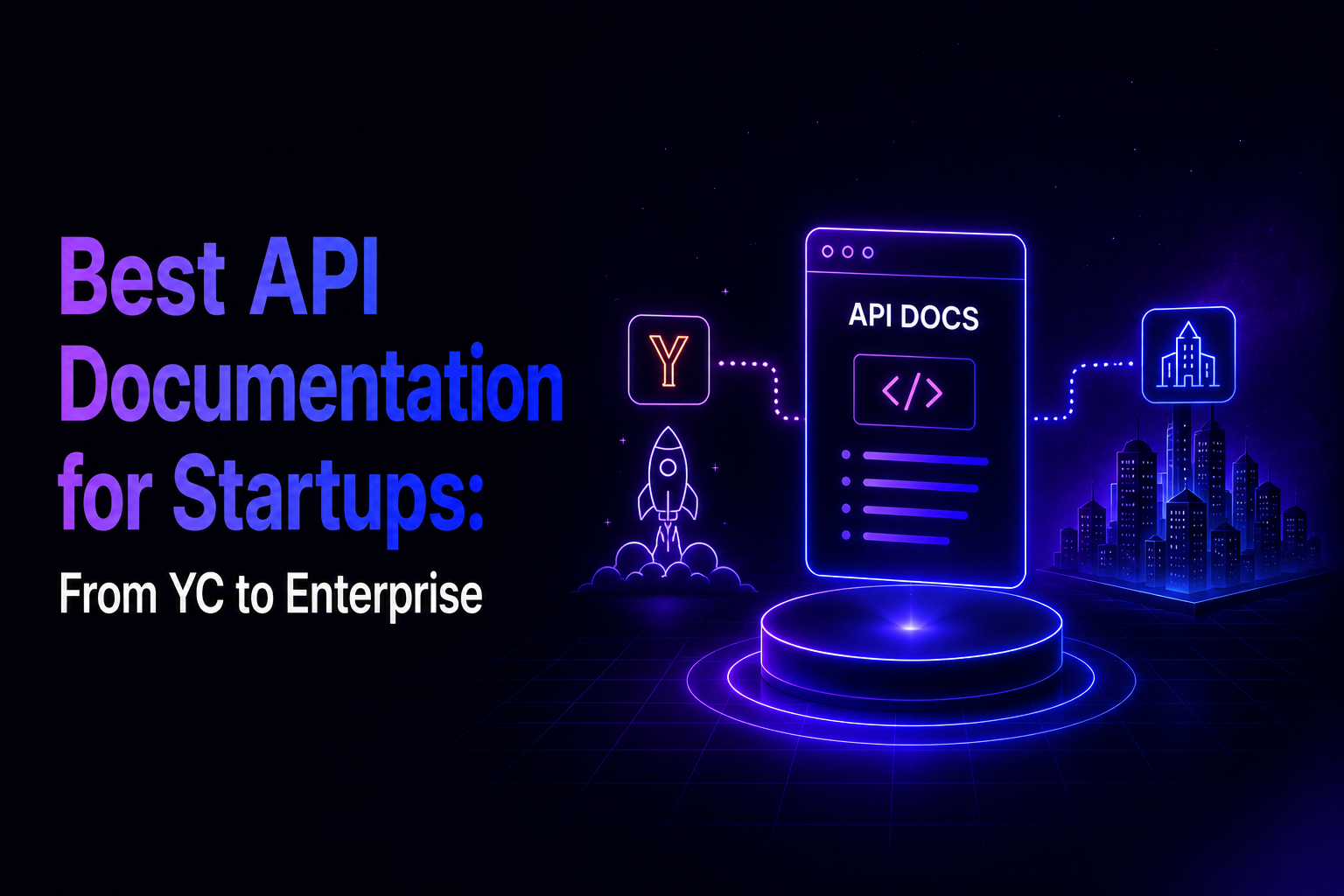
A startup program open to eligible early-stage teams, a free year for recent Y Combinator companies, free for open source, and the same platform Ticketmaster, Corgi, FIS and thousands of companies run on.
Your API docs have one job right now: get a developer, or the AI agent working on their behalf, to a successful request without asking anyone for help.
Most documentation platforms can do that. The question is what you pay to find out, and whether the thing you pick at forty endpoints still works at four thousand.
Theneo is free to start, free for open source, and free for a full year if you are coming out of a recent Y Combinator batch.
What eligible startups get, and how it compares
Theneo's startup program is open to eligible early-stage startups. You do not need to be in an accelerator to apply.
What you get is the Growth annual tier, which is the top self-serve plan. Recent Y Combinator batch companies get a full year free. Other eligible startups get significant discounts on the same tier.
The same platform runs API documentation for Ticketmaster, Corpay, FIS and thousands of companies. That means SOC 2 Type II, ISO 27001 and ISO 9001, GDPR compliance with EU data residency, SSO and role-based access, audit logs, and self-hosting if you need it.
A year of Growth includes 20 developer portals, 7 projects, a custom domain, custom CSS, full white-label branding, unlimited AI that is not metered by credit, IP allowlisting, custom analytics, and 1:1 support over Slack or Teams with the people who build the product.
Compare that to the closest equivalent. Mintlify's startup program gives eligible venture-backed startups six months of Pro. Twelve months is reserved for companies in the current YC batch only.
So: twice the term, the top tier rather than a mid tier, and recent batches count rather than only the current one.
Email hello@theneo.io to check eligibility and activate. Import your spec first if you want to arrive with something running. Nothing gets rebuilt when the program ends. Same project, same URLs.
Open source is free
If your API or library is public and your docs are open to everyone, you do not need the startup program or a paid plan. Email hello@theneo.io with a link to your repository.
How do you set up API documentation for a startup?
At forty endpoints, the whole sequence below takes about a day.
Import the spec. OpenAPI, Swagger, AsyncAPI, GraphQL, gRPC or a Postman collection. You get an interactive reference with a live API Explorer, so a reader fires a real request from the page instead of copying curl into a terminal. AI drafts descriptions for the endpoints nobody documented, so your first pass is editing, not staring at a blank page.
Write one quickstart. Five minutes, one working request, realistic data. Time to first successful call is the only onboarding metric that matters at this stage.
Turn on Ask AI. Developers get an answer grounded in your docs instead of a list of search results. For a team of three, that is the difference between a docs site and a support queue.
Publish the agent layer. Theneo exposes llms.txt, llms-full.txt and per-section Markdown automatically. The configuration walkthrough covers validation.
Generate an MCP server. One CLI command, scoped per project rather than per workspace, so you can expose one API to agents without exposing everything else you are building. Here are the commands.
Do API docs need to be designed for AI agents?
A developer asks Claude or Cursor to integrate your API. The assistant reads your docs, plans the calls, writes the code. If your parameter descriptions are missing, it cannot infer them. If your auth flow lives in a Slack thread, it guesses. Then the developer files a ticket.
Postman's 2025 State of the API Report surveyed over 5,700 developers, architects and executives. It found 89% use generative AI daily and 41% use it to generate API documentation, but only 24% design APIs with agents in mind. Another 60% still design for humans only.
You can cross that line in a day at forty endpoints. You cannot at four hundred. Being small is the advantage here, and it expires. Our breakdown of why API specs break AI agents covers the schema side.
On MCP specifically: two-thirds of developers know about it, 10% use it regularly. Shipping one now is still a differentiator. That window is closing fast. See how llms.txt and MCP are changing API discovery.
How do you keep API documentation up to date when you ship daily?
Postman found documentation gaps to be the most reported collaboration problem in the industry, hitting 55% of respondents. Nobody fails at this because they do not care. They fail because nobody updates docs during a Thursday night deploy.
Three things make it structural rather than a habit.
Publish from CI. Verified GitHub Action, full CLI, bi-directional GitHub and Bitbucket sync, VS Code extension, Postman sync. Docs ship from the same pipeline as code, and the whole workflow runs from the terminal if that is where you live. Preview deployments are unlimited on every plan including the free one, so a doc change gets reviewed like a code change.
Catch breaking changes automatically. The changelog flags them instead of waiting for a customer to find one in production. More in our guide to managing API changes.
Let non-engineers edit. Engineers in Markdown, everyone else in a visual editor, same document, live cursors, comments, approvals, version history. Specs still sync through Git.
That last one is where docs-as-code quietly fails. When every change needs a pull request, your solutions engineer needs a developer to fix a wrong error message. So the wrong error message stays. At three people you will not notice. At fifteen you will.
Does Theneo support docs-as-code and Git workflows?
The usual assumption is that picking a platform means giving up docs-as-code. With Theneo it does not.
There is a verified GitHub Action, a full CLI, bi-directional GitHub and Bitbucket sync, a VS Code extension and Postman sync. You can run the entire documentation workflow from your terminal or your pipeline and never open the editor once. You can also export your docs back out as a valid OpenAPI spec with a single CLI command, even if you never had one to begin with.
The editor is there for the people who need it, not for you. Engineers stay in Markdown and Git. Support, product and solutions edit the same document without filing a pull request. You are not picking one or the other, which is the actual difference between this and a static site generator.
The one case where you genuinely do not need any of this: a dozen internal endpoints, no external consumers, and no plans for any. Publish a README and revisit the question the first time someone outside the company integrates.
When you need private customer portals
Around design partner three, which arrives well before Series A. One customer is on a pilot. One has an unreleased endpoint. One is a regulated buyer who wants your docs under their branding.
Theneo does authenticated per-customer portals with individual logins, SSO, scoped visibility, per-segment branding, and analytics showing which customers read which pages and where they stopped. A design partner abandoning your auth page three days before they go quiet is product feedback you cannot get any other way.
Access controls are on the free plan. Per-customer portals are on Business. Several competitors put SSO and role-based access behind Enterprise sales, so check that wherever you land. Background in our guide to developer portals.
How much does API documentation cost for a startup?
Starter is free forever and is a production tier, not a trial: one public project, two private, up to 2,000 endpoints, automated changelogs, the API Explorer, access controls, analytics, 20 team members.
Business is $150 a month per workspace, or $120 billed annually. Growth is $450, or $400 annually. Check the pricing page before deciding, because everyone in this category changes their numbers.
Two things matter more than the sticker price when you are small.
Seats. Most platforms include three to five and bill per head after that, which punishes exactly the behaviour you want: support and product fixing docs themselves instead of filing tickets at engineering. Theneo's free plan includes 20.
AI billing. Some platforms meter AI in credits, with overages billed per credit. Your docs bill then rises the more your docs get read, so a good launch turns into an invoice. Theneo includes AI usage in the flat tier.
Mintlify is the usual comparison, and its design defaults are genuinely excellent. If your team is engineer-only and lives in Git, it is a real option. What bites startups is the credit metering and the missing self-serve middle tier, which sends you from free straight to a custom quote at the exact moment you have no leverage. Our full comparison lines up seats, AI billing, editing model and hosting. Migration is free and takes a couple of hours with URLs preserved.
Every plan exports back to an OpenAPI spec and Markdown. Check that anywhere you go.
How do you choose an API documentation platform?
Skip the feature checklists. Run one real integration on every platform you are considering:
- Import your actual spec, not the sample.
- Publish a quickstart and one endpoint.
- Hand it to a developer who did not build the API. No help.
- Point an agent at it through MCP and ask it to make a call.
- Time both and count every question that went to a human.
Whichever gets a person and a machine to a successful request fastest wins. On Theneo that test costs nothing, and if you qualify for the startup program, neither does the year after it.
Email hello@theneo.io to check eligibility.
Frequently Asked Questions
Who is eligible for Theneo's startup program?
Eligible early-stage startups, whether or not they came through an accelerator. Recent Y Combinator batch companies get the Growth annual tier free for a year, and other eligible startups get significant discounts on the same tier. Email hello@theneo.io to check.
Is Theneo free for open source projects?
Yes! If your API or library is public and your docs are open to everyone, you do not need the startup program or a paid plan. Email hello@theneo.io with a link to your repository.
Can you use Theneo entirely from the CLI without the editor?
Yes. There is a verified GitHub Action, a full CLI, bi-directional GitHub and Bitbucket sync, a VS Code extension and Postman sync. You can run the whole workflow from your pipeline and never open the editor, and export back to an OpenAPI spec with one command.
How do you make API documentation readable by AI agents?
Publish a machine-readable layer alongside the human one: llms.txt, llms-full.txt, per-page Markdown, and an MCP server so agents can call your API rather than only read about it. Theneo generates all four from your spec automatically.
How is Theneo different from Mintlify for startups?
Theneo gives eligible startups a full year of its top tier against Mintlify's six months of a mid tier, includes AI in flat pricing instead of metering credits, has a $150 self-serve middle plan, and lets non-engineers edit without a pull request. Migration is free and preserves URLs.